
How to Write YouTube Titles That Rank — and Get Clicked
The title is the highest-leverage text you will write for any video: seventy characters that decide whether YouTube shows you in search and whether a human, seeing you next to five competitors, picks you. Most advice treats those as one problem. They are two different jobs, and good titles do both on purpose.
The two jobs of a title
Job one is ranking: YouTube's search system reads your title to understand what the video is about, and matching the words people actually search is still one of the strongest signals you control. Job two is the click: once you appear in the results, the title (with the thumbnail) is the entire sales pitch. A keyword-perfect title nobody wants to click ranks briefly and sinks; an irresistible title with no searchable words never surfaces in the first place. Write for both, in that order.
Keyword placement and length
Put the exact phrase you are targeting as close to the start of the title as natural English allows. "iPhone 17 camera test: 4K night footage" beats "I took my new phone out at night and filmed this (camera test!)" for the query "iphone 17 camera test" — same video, very different ranking odds. Front-loading also survives truncation: search results and suggested feeds cut long titles, and whatever is cut cannot convince anyone.
On length, aim under roughly 65 characters. YouTube allows 100, but display truncation starts around 60-70 depending on the surface, and the data across niches consistently favors shorter, denser titles. If you cannot fit everything, the keyword and the promise stay; the rest goes.
Patterns that reliably earn clicks
Some structures keep working because they compress information viewers want: numbers ("7 mistakes...", "in 12 minutes"), brackets that add a qualifier ("(2026 guide)", "[no equipment]"), the current year for anything time-sensitive, and contrast or stakes words — mistake, stop, before, actually, nobody. These are seasoning, not the meal: one or two per title, only where true.
The honesty constraint is practical, not moral: YouTube measures what happens after the click. A title that overpromises buys a click, then the viewer leaves in forty seconds, watch time craters, and the algorithm quietly stops recommending the video. The best-performing titles are accurate promises the video actually keeps.
The mistakes that quietly hurt
ALL-CAPS titles read as shouting and test poorly outside a few entertainment niches — capitalize a word, not the sentence. Vague curiosity ("You won't believe what happened") contains zero searchable words and ages terribly. And copying the exact template every competitor uses makes you invisible in a results page where five titles are near-identical; when the first page all says "Ultimate Guide", the title that says something specific wins the scan.
Test the title before the video exists
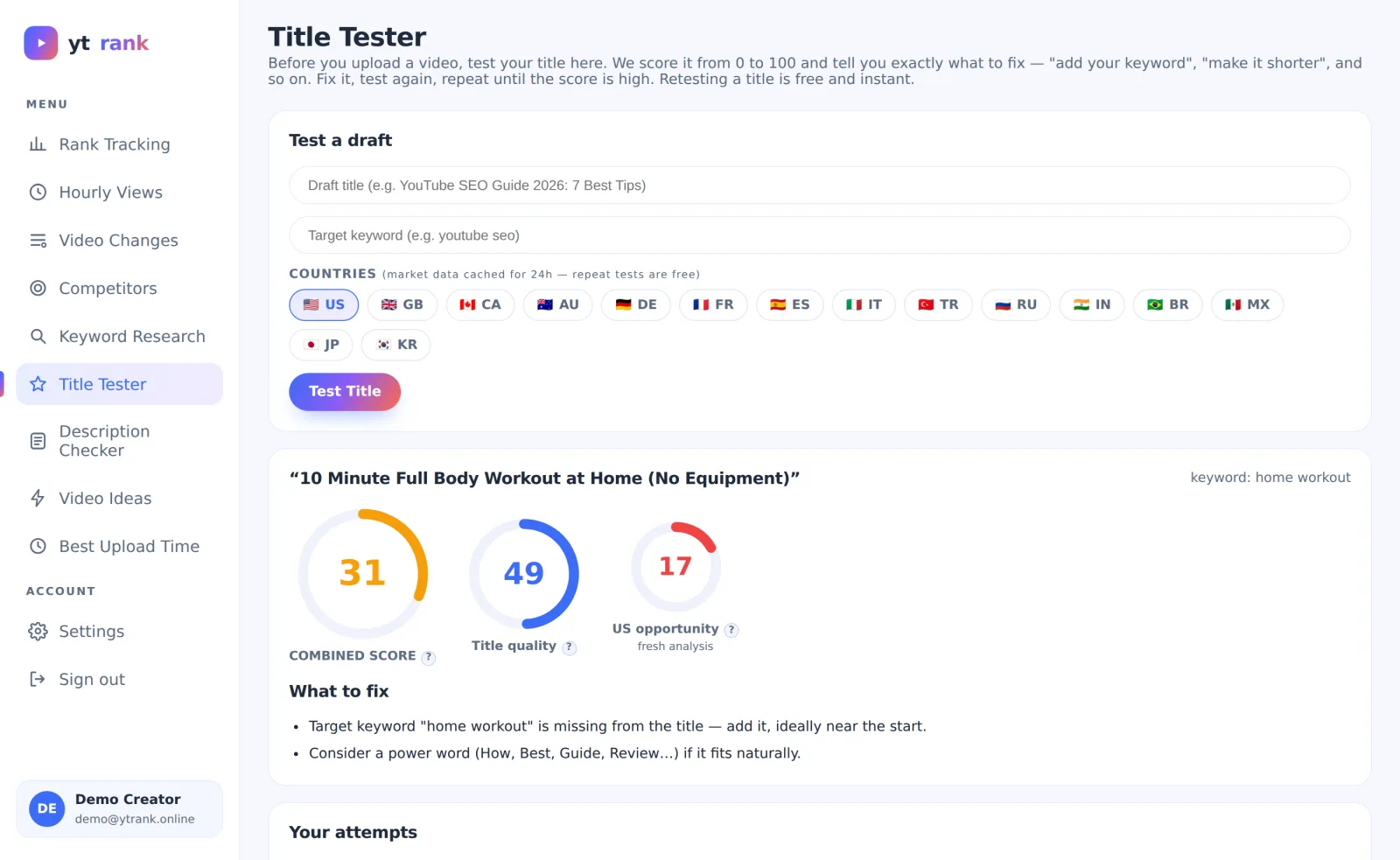
Because the title is decided before upload, it is also testable before upload. ytrank's Title Tester takes a draft title plus its target keyword and scores the mechanics — length, keyword position, readability patterns, similarity to what already ranks — and combines it with how winnable that keyword actually is, with a concrete fix list. Write three candidate titles, run them all, and keep the attempts table open: choosing with numbers beats choosing by mood, and it takes two minutes.
Then treat the title as an experiment after publishing too: if a video underperforms its content, a title rewrite is the cheapest second chance it will ever get — and your rank tracker will show you within days whether the rewrite moved you.