
The First 48 Hours of a YouTube Video: What Matters and What Doesn't
The hours right after publishing are the most nervous — and the most mythologized — part of a video's life. YouTube really does use early signals to decide how widely to test a video, but most of what creators do in those hours is either useless or actively harmful. Here is what the first 48 hours actually decide, what to watch, and when (if ever) to intervene.
What the first 48 hours actually decide
When a video goes live, YouTube shows it to a test audience — subscribers first, then widening circles if the response is good. Strong click-through and retention in that window earn a bigger test; weak signals shrink it. This is why two videos of equal quality can diverge wildly: one caught its audience awake, the other launched into silence.
What the window does NOT do is seal the video's fate. Search rankings build over weeks, and plenty of videos find their audience on day 30 — the exploration phase is an opening bid, not a verdict.
Before you publish: stack the deck
Most first-48-hours wins are locked in before the video exists publicly. Publish shortly before your audience's most active window — from your own viewing-hour data, not folklore about Tuesdays. Have the title tested against its keyword, the description scored, and rank tracking armed for your target phrases so the ranking curve is captured from hour one. Scrambling to fix metadata two hours after launch is exactly the wrong order.
Hours 0-6: watch, share, reply — do not edit
Turn on high-resolution monitoring (5-minute pulse if you have it) and share the video where your audience genuinely lives — community tab, newsletter, one or two relevant communities. Reply to every early comment: early engagement is a real signal and replies double it. What you should NOT do: change the title or thumbnail because the first hour looks slow. The test audience is still tiny; you would be reacting to noise.
Day 1-2: read the curve, not the total
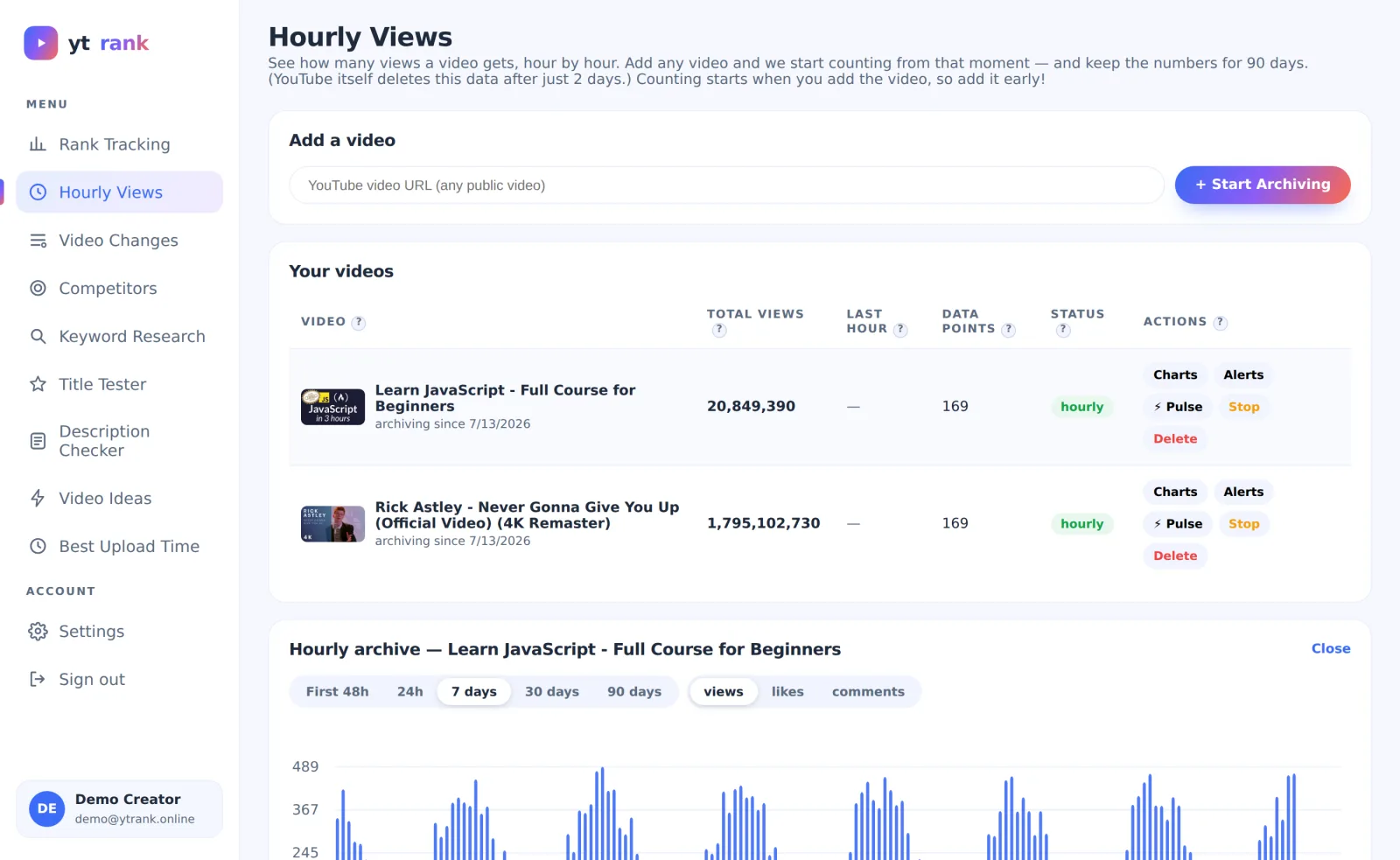
An hourly view curve tells you which story you are in. Steady climb with rising engagement: the test is going well, do nothing. Sharp spike then cliff: you got an external burst that did not convert — normal, not a crisis. Flat from the start with good retention on few views: a packaging problem, not a content problem — this is the one scenario where an early thumbnail or title revision is justified, ideally changing one element and watching the next 24 hours.
Also check where views come from. If search traffic appears within the first day, note which phrases — those are keywords worth doubling down on in the description and in future videos.
The panic edits that make things worse
Re-uploading the video to 'reset' the algorithm throws away every accumulated signal and starts from less than zero. Changing title, thumbnail AND description simultaneously makes it impossible to know what helped. Deleting and re-adding tags does nothing. Buying views actively poisons your retention statistics. The discipline that wins: one deliberate change at a time, measured over a real interval — or, most often, no change at all while the test plays out.